










UAE E-Invoicing 2026: How Businesses in Dubai Can Prepare for the Next Phase of Digital Compliance
The UAE is entering a new era of digital tax compliance with the introduction of its national electronic invoicing (e-invoicing) framework. While many businesses already issue invoices electronically as PDFs, the upcoming system goes far beyond simply sending invoices by email.
Under the new framework, invoices will be generated, exchanged, and processed in a structured digital format that allows businesses, service providers, and government authorities to handle invoice data automatically. The initiative forms part of the UAE’s broader digital transformation strategy and is designed to improve efficiency, transparency, and tax compliance across the economy.
For businesses in Dubai, the question is no longer whether e-invoicing is coming – it’s whether your systems, processes, and teams will be ready when implementation becomes mandatory.
What Is UAE E-Invoicing 2026?
E-invoicing is the electronic creation, exchange, and processing of invoice data in a structured format that can be automatically read and processed by software systems.
Unlike traditional PDF invoices, structured electronic invoices contain standardized data fields that enable accounting systems, ERP platforms, customers, suppliers, and government authorities to exchange and process information without manual intervention.
The UAE’s framework is based on the internationally recognized OpenPeppol standard, which is widely used for secure and interoperable electronic document exchange. The adoption of OpenPeppol aims to facilitate business transactions, improve data accuracy, reduce administrative costs, and support cross-border interoperability.
How the UAE E-Invoicing System Works
The UAE is implementing a Peppol-based model that relies on Accredited Service Providers (ASPs) to facilitate the exchange of electronic invoices.
In simple terms:
- A supplier generates an invoice in the required structured electronic format.
- The invoice is transmitted through an Accredited Service Provider (ASP).
- The invoice data is validated and securely exchanged between the relevant parties.
- Required invoice information is shared with the relevant authorities in accordance with regulatory requirements.
This approach creates a more automated, secure, and standardized invoicing ecosystem compared to traditional email-based invoice exchanges.
Who Needs to Comply?
According to the UAE Ministry of Finance, the e-invoicing framework primarily applies to:
- Business-to-Business (B2B) transactions
- Business-to-Government (B2G) transactions
Business-to-Consumer (B2C) transactions are currently excluded from the mandatory framework unless future regulations specify otherwise.
Businesses operating in mainland UAE and free zones should monitor official announcements and guidance to understand their obligations and implementation timelines.
UAE E-Invoicing 2026 Timeline
The Ministry of Finance has adopted a phased implementation approach to provide businesses with sufficient preparation time.
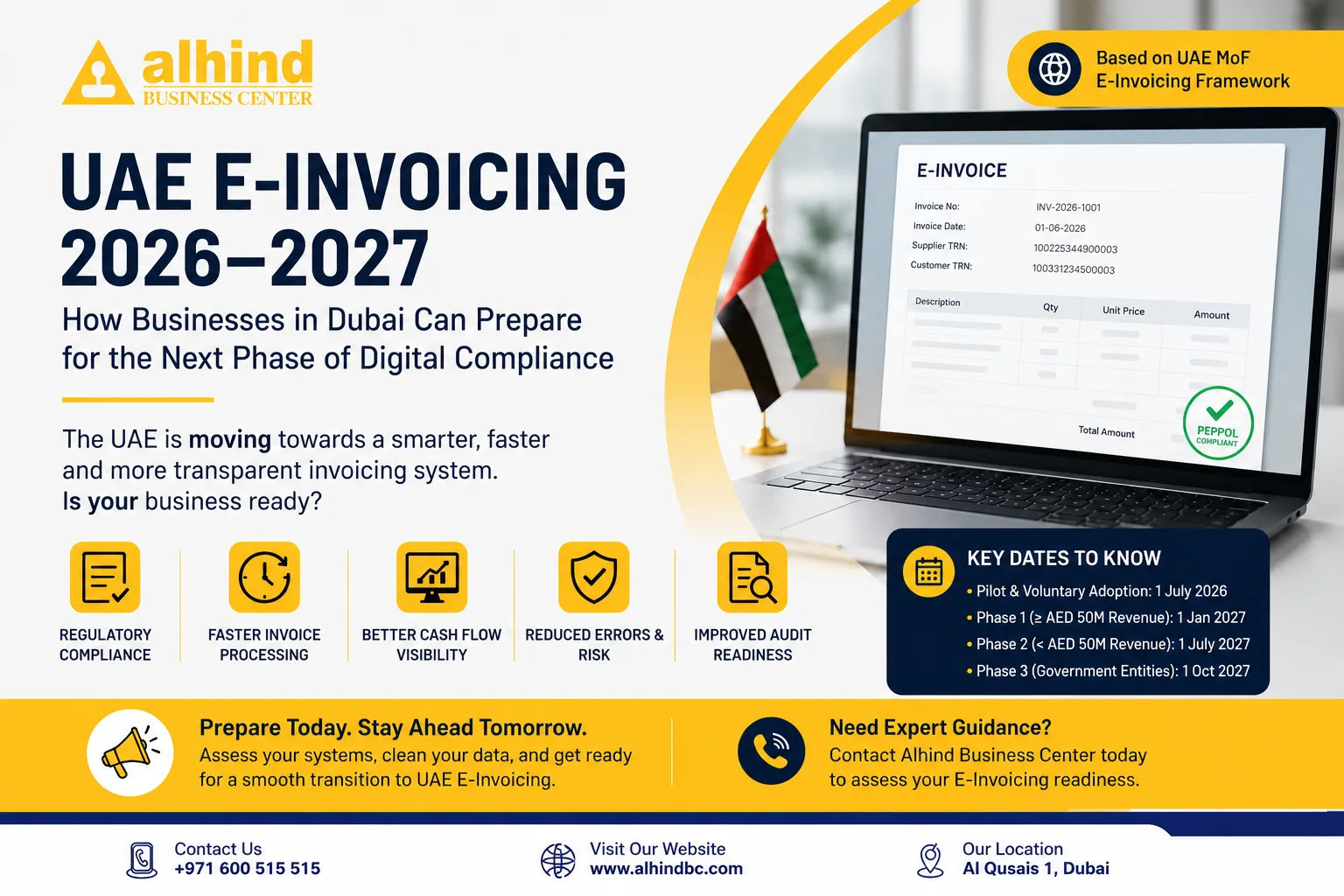
| PHASE | ORGANIZATION TYPE | ASP APPOINTMENT DATE | MANDATORY GO-LIVE DATE |
|---|---|---|---|
| Pilot Program | Selected taxpayers | As notified | 1 July 2026 |
| Voluntary Adoption | Any eligible business | Voluntary | From 1 July 2026 |
| Phase 1 | Businesses with annual revenue of AED 50 million or more | 30 October 2026 | 1 January 2027 |
| Phase 2 | Businesses with annual revenue below AED 50 million | 31 March 2027 | 1 July 2027 |
| Phase 3 | Government entities | 31 March 2027 | 1 October 2027 |
Businesses should continue monitoring Ministry of Finance announcements for any updates, clarifications, or implementation changes.
What Will Change for Businesses?
For many UAE companies, e-invoicing will require updates to both technology and internal workflows.
Once mandatory implementation applies to your business category:
- Structured electronic invoices will become part of the invoicing process.
- ERP and accounting systems may require upgrades or integrations.
- Customer and supplier master data must be accurate and complete.
- Finance teams will need updated procedures for invoice creation, approval, and reconciliation.
- Businesses will need to connect with an Accredited Service Provider (ASP) to meet regulatory requirements.
Organizations that begin preparing early are more likely to experience a smoother transition and avoid last-minute implementation challenges.
How to prepare for UAE E- Invoicing 2026
1. Review Your Current Systems
Assess whether your ERP or accounting software can support structured electronic invoicing and future integration requirements. Common platforms used in the UAE include:
- SAP
- Oracle
- Microsoft Dynamics 365
- Zoho Books
- Odoo
- TallyPrime
Businesses should verify whether their software provider supports UAE e-invoicing requirements, Peppol connectivity, ASP integrations, and future reporting obligations.
2. Clean Up Master Data
Structured invoicing depends heavily on accurate business information. Review and validate:
- Tax Registration Numbers (TRNs)
- Legal entity names
- Customer records
- Supplier records
- Contact information
- VAT-related data
Poor-quality data can lead to validation failures, processing delays, and compliance risks.
3. Evaluate Accredited Service Providers (ASPs)
Businesses should familiarize themselves with the role of Accredited Service Providers and monitor Ministry of Finance announcements regarding approved providers. Early evaluation can help organizations:
- Understand technical requirements
- Compare implementation approaches
- Budget accurately
- Avoid last-minute onboarding bottlenecks
4. Train Finance and Accounting Teams
Finance teams should understand:
- New invoicing workflows
- Electronic document management
- Credit note procedures
- Compliance responsibilities
- System integration processes
Training staff early reduces operational disruption during implementation.
5. Conduct an E-Invoicing Readiness Assessment
A structured readiness assessment can identify:
- System gaps
- Data quality issues
- Process inefficiencies
- Resource requirements
- Compliance risks
- Project timelines
The earlier these gaps are identified, the easier and less costly they are to address.
Recommended Preparation Timeline
To ensure a smooth transition, businesses should consider the following preparation roadmap:
Q3–Q4 2026
- Assess ERP and accounting systems
- Review master data quality
- Evaluate ASP options
- Begin internal planning
Q4 2026
- Complete system upgrades and integrations
- Conduct testing and validation
- Train finance and accounting teams
Q1 2027
- Mandatory compliance for businesses with annual revenue of AED 50 million or more
Q2–Q3 2027
- Finalize implementation for businesses below the AED 50 million threshold
- Complete readiness testing and compliance reviews
Benefits Beyond Compliance
While many businesses initially view e-invoicing as a regulatory requirement, the operational benefits can be significant.
Potential advantages include:
- Reduced manual data entry
- Fewer invoicing errors
- Faster invoice processing
- Improved payment reconciliation
- Better cash-flow visibility
- Greater operational efficiency
- Enhanced audit readiness
- Improved data accuracy
For growing businesses in Dubai, these improvements can deliver long-term value beyond regulatory compliance.
Final Thoughts
The UAE’s e-invoicing initiative represents one of the most significant changes to business compliance processes in recent years. With pilot participation already underway and mandatory implementation beginning in 2027, businesses have a valuable opportunity to prepare before deadlines arrive.
Waiting until implementation deadlines approach may increase project costs and create unnecessary operational disruption. Conducting an e-invoicing readiness assessment now allows businesses to identify system, process, and data gaps before mandatory implementation begins.
Organizations that review their systems, improve data quality, and begin planning today will be better positioned to meet the new requirements while benefiting from more efficient financial operations in the future.
Need Help Preparing for UAE E-Invoicing?
At Alhindbc, we help businesses assess their e-invoicing readiness, review accounting systems, identify compliance gaps, and prepare for upcoming regulatory requirements.
Our specialists can assist with:
- E-invoicing readiness assessments
- ERP and accounting system reviews
- Compliance gap analysis
- Process optimization
- Implementation planning
- Staff training and support
Contact Alhindbc today to discuss how your business can prepare for the UAE’s e-invoicing transition with confidence.
Frequently Asked Questions (FAQ) About UAE E-Invoicing 2026
When will e-invoicing become mandatory in the UAE?
The UAE is implementing e-invoicing in phases beginning in 2026, with mandatory adoption starting in 2026 based on business size and category. Businesses should monitor announcements from the Ministry of Finance (MoF) and the Federal Tax Authority (FTA) for updates.
Will PDF invoices still be allowed?
A PDF invoice alone is not expected to satisfy the UAE’s structured e-invoicing requirements for transactions covered by the mandate. Businesses will need to generate and exchange invoice data in the prescribed structured electronic format.
Who needs to comply with UAE e-invoicing requirements?
The framework primarily applies to Business-to-Business (B2B) and Business-to-Government (B2G) transactions. Businesses operating in the UAE should review the latest guidance to determine their specific obligations.
Do free zone companies need to comply?
Businesses operating in UAE free zones are generally expected to be included within the e-invoicing framework unless specific exemptions are announced by the authorities.
What is an Accredited Service Provider (ASP)?
An Accredited Service Provider (ASP) is an approved intermediary that enables businesses to exchange electronic invoices through the UAE’s e-invoicing network while meeting required technical, security, and compliance standards.
Will I need to replace my accounting software?
Not necessarily. Many accounting and ERP providers are expected to introduce updates and integrations that support UAE e-invoicing requirements. Businesses should consult their software provider to understand what changes, if any, will be required.
What is PINT AE?
PINT AE (Peppol International Invoice UAE) is the UAE-specific e-invoicing standard being developed under the OpenPeppol framework. It defines the data requirements and invoice structure that businesses will use when exchanging electronic invoices within the UAE e-invoicing ecosystem.